
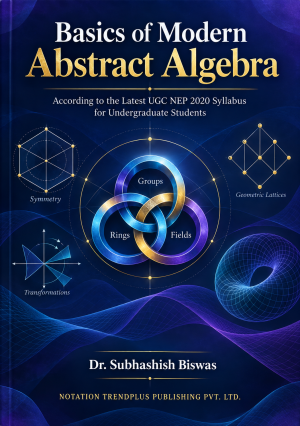
Basics of Modern Abstract Algebra
Synopsis
Abstract algebra is one of the fundamental branches of mathematics. It provides
a systematic framework for studying algebraic structures and the relationships
among them. The concepts introduced in this subject are essential not only for
advanced mathematics but also for applications in computer science, coding
theory, cryptography, physics and other scientific disciplines.
This book, Basics of Modern Abstract Algebra, has been prepared primarily for
undergraduate students studying mathematics under the UGC NEP 2020 curric
ulum. It is intended to provide a clear, logically organized and accessible intro
duction to the basic concepts of abstract algebra. The presentation begins with
elementary ideas and gradually develops the subject through definitions, exam
ples, theorems, proofs and exercises.
The book is organized into four chapters. Chapter 1 introduces sets, subsets,
mappings, families of sets, equivalence relations and the properties of integers
required for the subsequent study of algebra. Chapter 2 develops group theory,
including subgroups, cosets, homomorphisms, permutation groups, symmetric
groups, direct products, semidirect products and finite Abelian groups. Chapter
3 discusses vector spaces, linear transformations, linear independence, bases and
dual spaces. Chapter 4 presents rings and modules, including quotient rings,
fields of quotients, principal ideal domains, polynomial rings and modules over
principal ideal domains.
The book may be used as a classroom textbook, a reference source or a guide
for independent study. It is hoped that the systematic arrangement of the materi
al will help students develop mathematical maturity and prepare them for fur
ther study in algebra and related areas.
Published
September 21, 2026
Copyright (c) 2026 NOTATION TRENDPLUS PUBLISHING PRIVATE LIMITED
Details about the available publication format: PDF
PDF
ISBN-10 (Discontinued)
81-17045-04-6
ISBN-13 (15)
978-81-17045-04-6
Physical Dimensions
Details about the available publication format: E-Book
E-Book
ISBN-10 (Discontinued)
81-17045-05-3
ISBN-13 (15)
978-81-17045-05-3
How to Cite
Basics of Modern Abstract Algebra. (2026). NOTATION TRENDPLUS PUBLISHING PRIVATE LIMITED. https://notationpublishing.com/1/catalog/book/1


